TRUSTED BY THOUSANDS NATIONWIDE!
Better Business Bureau

Sports Cards vs Pokémon Cards: Which Is the Better Investment?

By David Solow | December 7, 2025


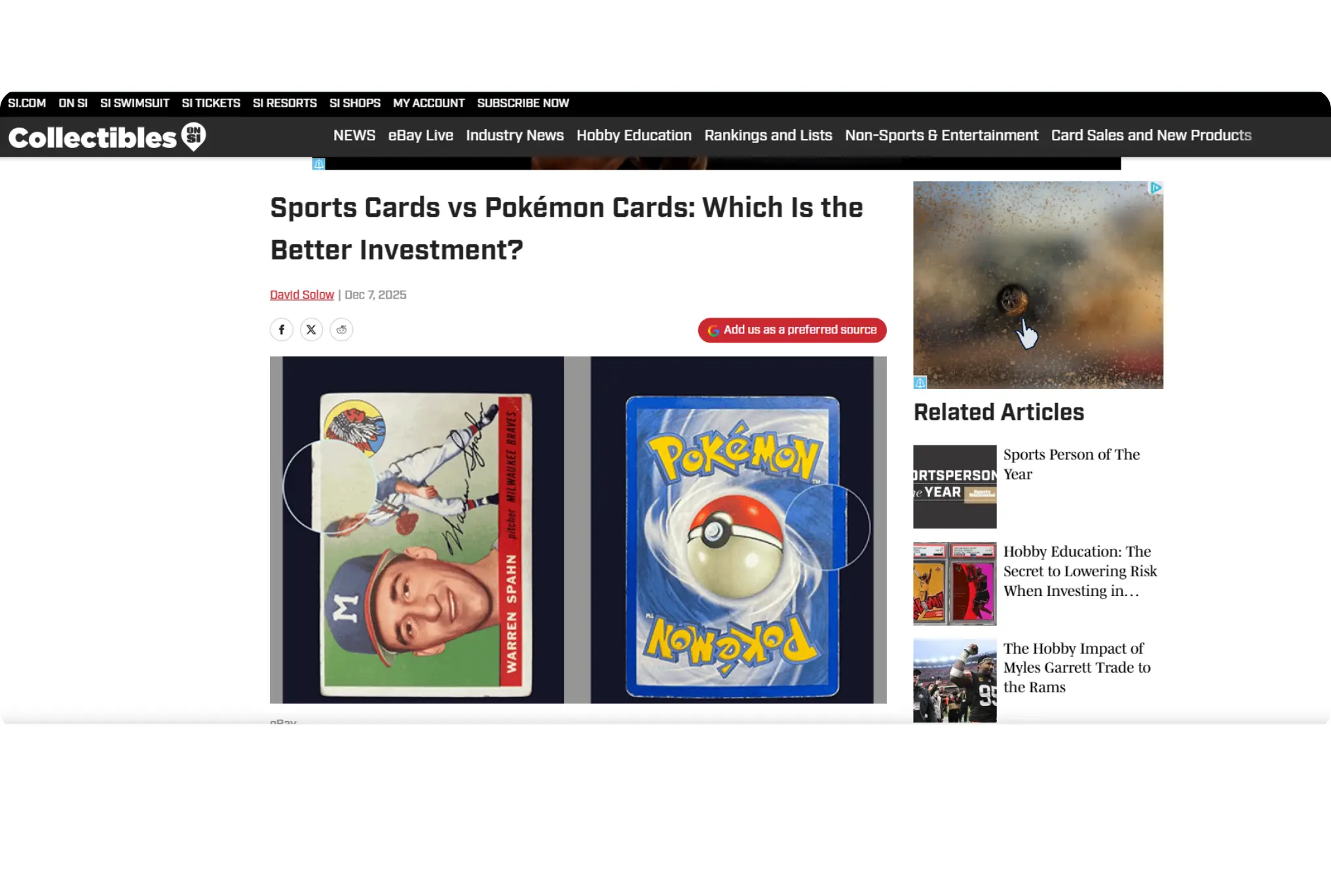
Why do people collect sports cards or Pokémon cards? This question opens a deeper look into human behavior: why do people collect anything at all?

Sigmund Freud theorized that the urge to collect things is linked to specific early childhood development stages, particularly those related to toilet training. (This was his actual theory.) Some psychologists say collecting gives us a sense of control and identity in a chaotic world.

When looking past the underlying psychological causes, collecting both sports cards and Pokémon cards fulfills similar desires for nostalgia and the pride of ownership of something special.

Another reason people buy trading cards is the hope of financial gain. Both Pokémon and sports cards have become recognized as alternative investments, with companies like Qollateral and JM Bullion even offering loans backed by high-value graded cards. Some hedge funds now treat trading cards as a legitimate asset class.

Both markets are booming, but Pokémon cards are hotter at the moment. Which will prove to be the better long-term investment?

Why Sports Cards Might Be the Better Long-Term Play:

1.    Sports Cards Have a Longer History and a Proven Track Record of Success

Sports cards originated in the late 1860s when tobacco companies used them as promotional inserts to stiffen cigarette packs and boost sales. This contrasts with Pokémon cards, which first appeared in Japan in 1996. The sports card hobby has over a century of established history before Pokémon even existed.

The “Holy Grail” T206 Honus Wagner card was produced between 1909 and 1911 by the American Tobacco Company. This card, often called the “Holy Grail” of the entire trading card hobby, sold for over $7.25 million in 2022. Its sustained value over more than a century provides a clear example of long-term investment success that Pokémon has yet to match in terms of sheer time frame.

The act of collecting sports cards became a staple of American youth culture in the 1950s and 60s. It is a tradition passed down through generations of families. There is a deep cultural and nostalgic foundation with sports cards that has weathered market fluctuations.

In 2024, PSA graded 9.10 million sports cards and 6.23 million TCG/non-sports cards, showing sports cards are still King in the trading cards world.

2.    Sports Cards Have Real-World Anchors

The players are real people whose careers, stats, and championships create lasting storylines. When an athlete does something historic, their cards can surge overnight in a way that feels directly tied to reality.

Sports also have a type of presence that Pokémon can’t match. Baseball, basketball, and football dominate television, streaming, and social media. When Shohei Ohtani hits three home runs in a playoff game or LeBron James breaks another record, those moments immediately spark demand and bring in new collectors.

The “Mr. Wonderful Sports Card Index,” created by investor Kevin O’Leary, tracks the performance of his high-end sports card portfolio. O’Leary purchased the most expensive card ever sold (a one-of-one Michael Jordan and Kobe Bryant card that went for nearly $13 million.) He focuses exclusively on sports cards, not Pokémon, viewing them as blue-chip assets with long-term stability and real-world value.

3.    Baseball, Football, and Basketball are more Embedded in American Culture than Pokemon

Sports have a cultural reach and generational loyalty that Pokémon can’t replicate. In 2024, over 160 million Americans identified as fans of at least one major U.S. sports league, according to Statista data, while Pokémon’s active U.S. fan base is estimated at under 25 million.

While Pokémon is currently the highest-grossing media franchise in the world, its dominance in the future is not guaranteed. Another cartoon or anime series can use the same specific synergy between video games, merchandise, and the anime as Pokémon.

Pokémon’s creators themselves have stressed that constant innovation is key to its longevity. Sports are real life, and unlike Pokémon, do not have the pressure to constantly innovate to stay relevant.

Why Pokémon Might Hold the Edge:

1. Pokémon is widely considered the highest-grossing media franchise in the world

As of recent reports, Pokémon’s total estimated lifetime revenue surpasses that of other major intellectual properties, including those owned by Disney and Marvel.

As of August 2025, Pokémon remains the highest-grossing media franchise in the world, with an estimated $113.7 billion in total revenue. It leads by a wide margin over Mickey Mouse & Friends at $61.2 billion and Winnie the Pooh at $50.2 billion.

The enormous reach of the franchise has helped Pokémon cards become one of the most recognizable and lucrative collectibles in the world. The cards are attracting collectors in countries where baseball and basketball are barely known.

2. Pokémon Cards are Safer in Multiple Ways

Pokémon characters never get injured, retire, or face scandals that can destroy a player’s reputation and market value. “Charizard will never tear an ACL” is a common argument Pokémon fans make when arguing against sports cards, and it’s true.

Pokémon packs almost always provide a stronger return on investment. Sports hobby boxes are usually driven by the chance of landing one or two high-end rookies or chase cards. Most other cards in those boxes are nearly worthless. With Pokémon, every pack has consistent long-term appeal because collectors value so many different characters.

When enough sports card collectors get burned by overpriced hobby and retail boxes, the greed of sports cards companies can backfire. Even entire sports card sets lose value when the rookie class underperforms. By contrast, Pokémon sets tend to appreciate over time regardless of what happens in the real world.

3. Trading Card Games and Pokemon Sales are Red Hot with No Signs of Slowing Down

Recently, the surge in Pokémon’s popularity has become so intense that it’s sparked real-world chaos. Reports of shoppers fighting over Pokémon cards at Costco and other retailers have become increasingly common. The ceiling of these TCG cards has not been reached, but we know there is a high floor for these cards as well.

Pokémon cards have a high floor because there is a real utility beyond collecting. They are part of a global trading card game that attracts millions of active players, creating steady demand from both gamers and collectors. According to The Pokémon Company, more than 100 million people worldwide have played the Pokémon Trading Card Game in some form, either online or in person. This active player base keeps older cards relevant and constantly introduces new fans to the hobby.

Sports cards, by contrast, are mostly driven by speculation. Many buyers are flippers chasing short-term profits from rookies or hype cycles. When those players underperform or the market cools, prices crash and collectors get burned.

The utility gives Pokémon cards a much higher floor. Even if market prices dip, players still buy and trade cards to build decks and compete.

The Final Verdict:

In the long run, sports cards have the advantage. While most cards will lose value over time, the legends and all-time greats will hold their worth better than any Pokémon character. Sports are deeply rooted in the American life in a way that no cartoon or game can truly replace.

Both markets, however, will continue to grow. The two sides strengthen each other, blending nostalgia, creativity, and investment. It is funny to think of the power of owning a small piece of cardboard with a picture of a man playing sports or a cartoon monster that breathes fire. Both are equally nonsense, but both are equally awesome.

→ Read the article on Sports Illustrated.

Get An Offer Within 30 Minutes
No Obligation • Private & Secure
Get Started
212-287-5257
Share This Post:
Content Disclaimer

The content provided by Qollateral, LLC is for informational purposes only, you should not construe any such information or other material as legal, tax, investment, financial, or other advice. Nothing contained on our Site constitutes a solicitation, recommendation, endorsement, or offer by Qollateral, LLC or any third party service provider to buy or sell any commodities, securities or other financial instruments in this or in in any other jurisdiction in which such solicitation or offer would be unlawful under the securities laws of such jurisdiction. Qollateral, LLC is not an attorney, accountant or financial advisor, nor is it holding itself out to be, and the information contained on this Website is not a substitute for financial advice from a professional who is aware of the facts and circumstances of your individual situation.

All content on this site is information of a general nature and does not address the circumstances of any particular individual or entity. Nothing in the Site constitutes professional and/or financial advice, nor does any information on the Site constitute a comprehensive or complete statement of the matters discussed or the law relating thereto. Qollateral, LLC is not a fiduciary by virtue of any person’s use of or access to the Site or any content contained therein. You alone assume the sole responsibility of evaluating the merits and risks associated with the use of any information or other content on the Site before making any decisions based on such information or other content. In exchange for using the Site, you agree not to hold Qollateral, LLC, its affiliates or any third party service provider liable for any possible claim for damages arising from any decision you make based on information or other content made available to you through the Site.

Recommended Resources

How Qollateral treats luxury assets as working capital

Discover how Qollateral transforms luxury assets into working...

Sports Cards vs Pokémon Cards: Which Is the Better Investment?

Why do people collect sports cards or Pokémon...

Watch Condition Report: A Complete Guide for Borrowers and Collectors

Unlock the secrets of the Watch Condition Report...

Image

Unlock The Equity
In Your Assets.

Maximize your financial potential by
unlocking the equity in your assets.

Get Started
Chat