

 Updated June 10, 2026
 10 minute read
Selling a luxury asset that has appreciated can trigger a substantial capital gains tax bill. Borrowing against the same asset gives you access to liquidity without creating a taxable event, while keeping the asset and its future appreciation in your name.

This article explains how the strategy works, when it makes sense, and what to weigh before pursuing it. For high-net-worth individuals holding significant value in watches, jewelry, fine art, or collector vehicles, understanding the tax advantages of borrowing against luxury assets is worth exploring.
How to Avoid Capital Gains Tax on Collectibles: The Hidden Cost of Selling
When most people think about selling an appreciated asset, they think about the gain. What they often underestimate is the tax attached to it, and when the asset is a collectible, that tax can be higher than expected.
Consider an illustrative scenario: a Patek Philippe purchased for $500,000 a decade ago, now valued at $1.2 million. Selling it generates $700,000 in realized long-term capital gains. For most capital assets, such as publicly traded stocks, the federal long-term capital gains rate tops out at 20% for high earners. For collectibles, the IRS imposes a higher rate.
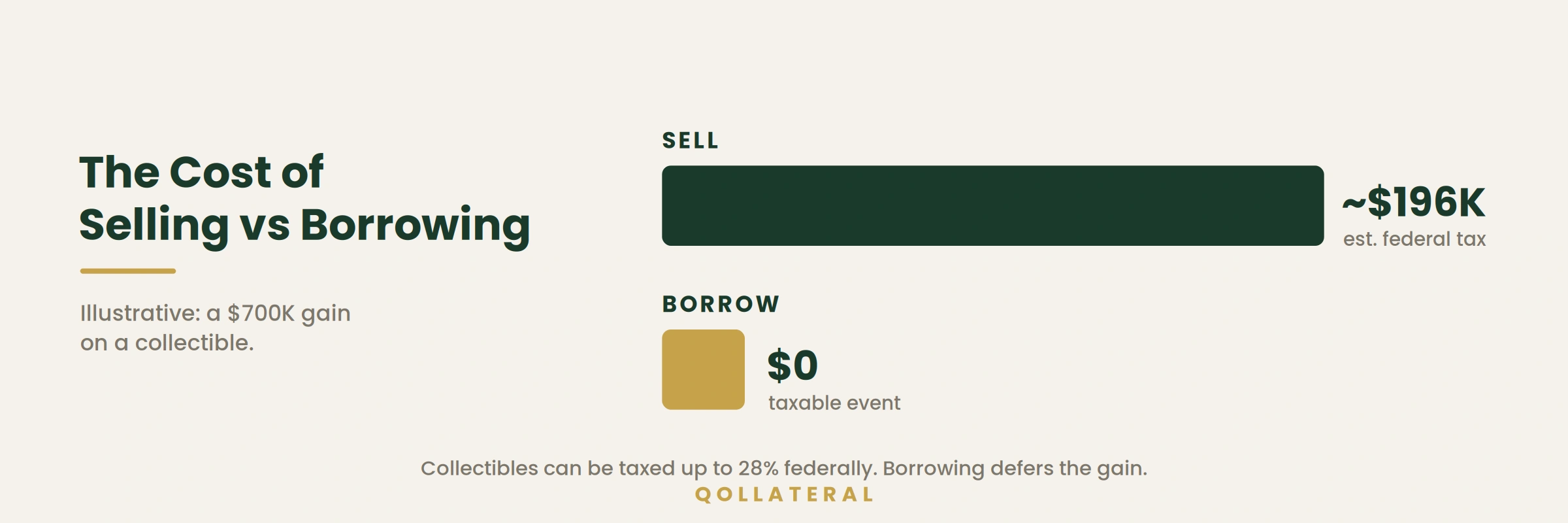
Under current IRS guidance, long-term capital gains on collectibles are taxed at a maximum federal rate of 28%. On that $700,000 gain, the federal tax alone could reach $196,000. For high earners, the 3.8% Net Investment Income Tax (NIIT) may also apply, pushing the effective federal rate higher still. State and local taxes layer on top depending on the owner’s location, and in high-tax states, the combined bill can exceed 40% of the gain.
A sale is not simply a liquidity event. It is a taxable transaction, and on collectibles, the rate is higher than many investors realize. Knowing how to avoid capital gains tax on collectibles, or more precisely, how to defer it, starts with understanding what triggers it: a realized gain. The asset must be sold and the proceeds received before the tax is owed.
Borrow Against Your Assets to Avoid Capital Gains Taxes
Loan proceeds are not taxable income. This is a foundational principle of the U.S. tax code. When you borrow money, you are creating a liability, an obligation to repay, not realizing a gain. No tax liability is triggered.
Returning to the scenario above: instead of selling the $1.2 million Patek Philippe and generating a significant federal tax bill, the owner borrows against it. The asset stays in their name. The $700,000 gain stays unrealized. The owner accesses liquidity, and the tax obligation is deferred until the asset is eventually sold.
This is not a permanent avoidance strategy. That distinction matters and is worth stating plainly. When the asset is sold, whether next year or in twenty years, the capital gains liability is realized at the rates applicable at that time.
What borrowing provides is a deferral of that liability combined with immediate access to capital. For owners who do not need to sell, who expect the asset to continue appreciating, or who want to control the timing of any future sale, the ability to borrow against your assets to avoid capital gains taxes in the near term can be a powerful financial tool.
How to Access Cash Without Selling Collectibles: When This Strategy Makes Sense
Not every situation calls for this approach, but several common scenarios illustrate when it may be worth exploring with a financial advisor.
- Short-term capital needs. The owner needs liquidity for a business opportunity, a real estate transaction, or a family liquidity event. Selling the asset is permanent; borrowing is temporary. If the owner expects to repay the loan relatively quickly, the interest cost may be substantially lower than the tax cost of a sale.
- Timing a taxable event. The owner anticipates selling eventually but wants to control when the gain is realized, perhaps to manage their tax bracket in a given year or to time the sale around other income events. A collateral loan bridges the gap.
- Preserving an appreciating or irreplaceable asset. The owner holds a watch, a piece of art, or a collector vehicle that may continue gaining value or that carries significance beyond its market price. Selling eliminates both the future upside and the asset itself.
- Portfolio liquidity without disruption. The owner wants to deploy capital elsewhere without liquidating a position they intend to hold for tax, sentimental, or investment reasons.
In each case, the key question is whether the cost of borrowing, primarily the interest on the loan, is lower than the tax cost of a sale. That calculation depends on the loan amount, the interest rate, the loan term, and the owner’s specific tax situation. A CPA or financial advisor is the right person to run that analysis.
The Buy, Borrow, Die Framework: How Luxury Assets Fit In
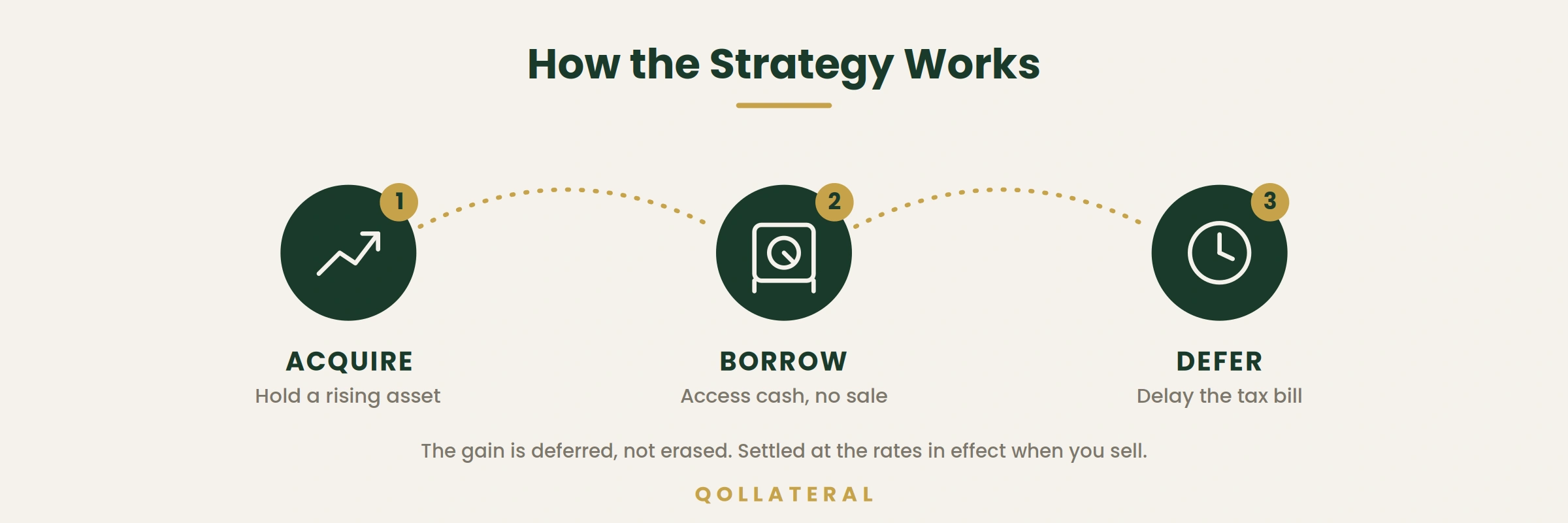
Sophisticated investors have long used a strategy known informally as “buy, borrow, die” to generate liquidity from appreciated assets without triggering capital gains. The framework works as follows: buy appreciating assets, borrow against them to access capital rather than selling, and upon death, potentially benefit from a stepped-up cost basis for heirs, which may eliminate the deferred capital gains liability under current tax law.
This approach has historically been associated with publicly traded stocks and real estate. As the luxury market has matured, the buy, borrow, die strategy for luxury assets has drawn increasing attention from wealth managers and high-net-worth clients who hold significant value in watches, fine art, diamonds, and collector vehicles. These assets share many of the characteristics that make the strategy viable: they appreciate, they have active secondary markets, and they can serve as collateral.
Two important caveats apply. First, the stepped-up basis benefit is a feature of current tax law and has been subject to ongoing legislative debate. It cannot be assumed to remain unchanged. Second, this article is not advocating the strategy; it is explaining how it works so readers can have an informed conversation with their own advisors.
Tax-Efficient Liquidity for Luxury Asset Owners: How Qollateral Fits In
For owners of luxury watches, fine jewelry and diamonds, exotic and collector vehicles, fine art, and gold and precious metals, sports cards, Pokemon cards, sports memorabilia & collectibles, Qollateral provides a practical vehicle for exploring tax-efficient liquidity strategies.
Qollateral’s collateral loans are same-day, non-recourse, and require no credit check or income verification. Loan amounts range from $2,000 to $10 million, depending on asset type and appraised value. Luxury car loans range from $50,000 to $2.5 million. Every transaction is fully confidential, with no credit bureau reporting and no public record.
The loan is secured by the asset itself, which is held in professional, insured storage for the loan term and returned in identical condition upon repayment. The asset never leaves the borrower’s ownership; it is temporarily pledged as collateral while remaining legally theirs.
For owners exploring their options, Qollateral offers a no-obligation, confidential evaluation. Learn how the process works or contact the team directly.
Important Considerations Before Pursuing This Strategy
This approach deserves careful analysis before being acted upon. A few points every reader should understand:
- Consult a tax professional. The information in this article is illustrative and educational. Individual tax outcomes depend on asset classification, holding period, income level, state of residence, how loan proceeds are used, and other factors that vary significantly by situation.
- Loan interest costs must be modeled against the tax savings. Collateral loans carry interest that accumulates throughout the loan term. For a short-term loan with a clear repayment plan, the interest cost may be significantly lower than the tax cost of a sale. For an extended loan without a repayment timeline, interest charges can grow to approach or exceed the tax liability that would have been triggered by selling. The math depends on your specific numbers.
- The gain is deferred, not forgiven. When the asset is sold, the capital gains liability is realized at the rates applicable at that time. Tax laws change, and the rates or rules in effect today may differ in the future.
- Defaulting on the loan means losing the asset. In a non-recourse loan, the pledged asset satisfies the outstanding balance if the loan is not repaid. The borrower does not recover any excess value if the asset’s market value exceeds the loan balance at the time of default.
- Asset classification matters. Not all luxury assets are treated identically under the tax code, and the 28% collectibles rate does not apply universally. Your tax advisor can confirm how your specific asset would be classified.
Frequently Asked Questions
Is a collateral loan considered taxable income?
No. Under U.S. tax law, borrowed funds are not income because they carry an obligation to repay. A loan creates a liability, not a realized gain. The moment a taxable event occurs with an appreciated asset is the moment it is sold, and the gain is received. Until then, the gain remains unrealized, whether or not the owner has borrowed against the asset.
What is the capital gains rate on collectibles?
The IRS taxes long-term capital gains on collectibles at a maximum federal rate of 28%, compared to a maximum of 20% for long-term gains on most other capital assets, such as publicly traded stocks. For high earners, the 3.8% Net Investment Income Tax may also apply. State and local taxes are additional. The IRS definition of collectibles includes works of art, gems, antiques, stamps, coins, and certain other tangible personal property. For the IRS’s own guidance on this rate, see IRS Topic No. 409. Whether a specific luxury asset qualifies as a collectible for tax purposes depends on individual circumstances. Consult a tax advisor.
Can I deduct interest paid on a luxury asset collateral loan?
It depends on how the loan proceeds are used. The IRS applies tracing rules, meaning deductibility is determined by the use of the proceeds, not the nature of the collateral. Proceeds used for qualifying investment purposes may qualify as investment interest expense, deductible up to the taxpayer’s net investment income for the year. Proceeds used for personal expenses are generally not deductible. Proceeds used for business purposes may qualify as a deductible business expense. See IRS Publication 550 for further guidance, and work with a CPA to determine how your specific use of proceeds affects deductibility.
What happens if I can’t repay the loan?
Qollateral’s loans are non-recourse. If the loan is not repaid, the pledged asset satisfies the outstanding balance. No further action is taken against the borrower, and there is no impact on credit history. Note that the borrower does not recover any excess value if the asset’s market value exceeds the loan balance at the time of default.
Does Qollateral report the loan to the IRS?
Qollateral, as a licensed, high-end pawnbroker, is subject to federal cash transaction reporting requirements under IRS Form 8300, which applies when cash transactions exceed $10,000. Qollateral’s standard transactions are funded and repaid via wire transfer, which is not subject to Form 8300 cash reporting requirements. The loan itself is not independently reported to the IRS in a manner that would appear on the borrower’s tax return. Readers should consult a tax professional regarding their own reporting obligations.
Ready to Explore Your Options?
If you own an appreciated luxury asset and want to understand your liquidity options before making any decisions, Qollateral offers confidential, no-obligation evaluations across watches, jewelry, diamonds, fine art, precious metals, and exotic vehicles. There is no commitment required to find out what your asset could work for you.
Contact Qollateral today for a discreet, no-pressure conversation with our team.
This article is for informational purposes only and does not constitute tax, legal, or financial advice. Tax outcomes depend on individual circumstances and applicable law. Readers should consult a qualified tax professional, CPA, or financial advisor before making decisions based on the information presented here.
