
 Updated October 23, 2026
 10 minute read
Rare watches combine tiny production numbers, demanding complications, and provenance that ties them to a notable owner or event. The rarest include one-of-a-kind Patek Philippe pieces, a Breguet pocket watch ordered for Marie Antoinette, and Rolex models with famous first owners. Four on this list have sold for more than $10 million at auction.
What Makes a Watch Rare
Five factors determine how rare a watch is, and every watch on this list meets several of them.
- Production numbers. Some watches exist as a single example. Others were made in batches of a few dozen or a few hundred.
- Complications. A complication is any function beyond telling the hours, minutes, and seconds. A minute repeater strikes the time on small gongs at the push of a slide or button. On a perpetual calendar, the date stays correct through months of different lengths and leap years without manual adjustment. Split-seconds chronographs use two stopwatch hands to time two events that start together. A watch that combines several of these is called a grand complication.
- Provenance. A documented link to a famous owner, a historic event, or a royal court can lift a watch’s value far above an otherwise identical example.
- Originality and condition. For rare vintage watches, originality means the dial, hands, case, and movement are the ones the watch left the factory with, and the case hasn’t been heavily polished.
- Auction history. A public sale creates a verified price that later buyers, sellers, and appraisers can refer to.
Ranking the Rarest Watches in the World
Only some of the rarest watches in the world ever reach the market. The ten below include four of the most expensive watches ever sold at auction and two more with published auction results. Two have no market price at all, and two are jewelry watches valued by the houses that made them.
1. Patek Philippe Grandmaster Chime Ref. 6300A-010
The Patek Philippe Grandmaster Chime Ref. 6300A-010 is the only Grandmaster Chime ever made in stainless steel. Patek Philippe built it for the Only Watch auction, a charity sale that funds research into Duchenne muscular dystrophy. Christie’s sold it in Geneva on November 9, 2019, for CHF 31 million, more than ten times its presale estimate. No watch has sold for more at auction since.
The watch has 20 complications on a reversible case with two dials, including five chiming modes. Two were world firsts: an alarm that strikes a preset time and a date repeater that sounds the date on demand. Patek Philippe rarely uses steel for a grand complication, so the case metal alone separates this watch from every other Grandmaster Chime.
2. Patek Philippe Henry Graves Supercomplication
New York banker Henry Graves Jr. commissioned the Patek Philippe Henry Graves Supercomplication in 1925 and received it in January 1933. He wanted a watch more complicated than any made for his fellow collector, automaker James Ward Packard. The gold pocket watch has 24 complications, including Westminster chimes, a perpetual calendar, and a chart of the night sky over New York.
It was the world’s most complicated watch until Patek Philippe’s Calibre 89 arrived in 1989. Sotheby’s describes it as the most complicated watch ever built without computers. The Supercomplication has appeared twice in Sotheby’s watch sales. At the most recent, a November 11, 2014, sale in Geneva, it sold for CHF 23,237,000, then a record for any watch at auction.
3. Rolex “Paul Newman” Daytona Ref. 6239
Joanne Woodward gave her husband a Rolex Cosmograph Daytona Ref. 6239 and had the caseback engraved “DRIVE CAREFULLY ME,” a reference to his racing career. Paul Newman wore it so often that collectors began calling Daytonas with its exotic dial style “Paul Newman” Daytonas. He later gave the watch to James Cox, a former boyfriend of his daughter Nell.
Phillips offered it in New York on October 26, 2017, with an estimate of about $1 million. After 12 minutes of bidding, it sold for $17,752,500, then the most expensive wristwatch ever sold at auction. That result placed it among the most significant rare Rolex watches ever offered. Other Daytonas with the same dial style sell for a small fraction of that figure, so the difference comes from Newman himself.
4. Patek Philippe Ref. 1518 in Stainless Steel
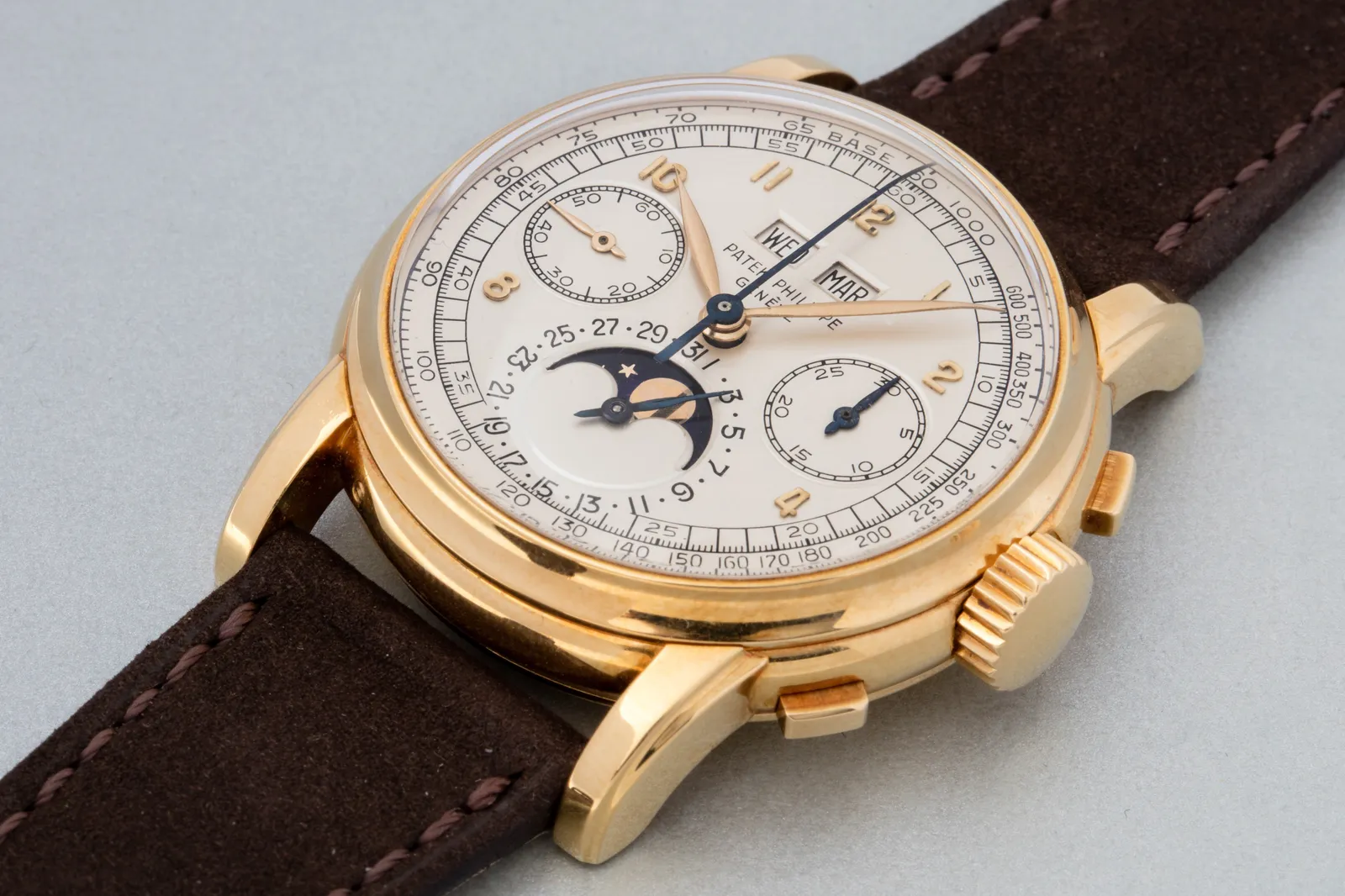
The Patek Philippe Ref. 1518 debuted in 1941 as the first perpetual calendar chronograph made in series. The company produced about 280 of them, most in yellow gold and roughly a fifth in pink gold. Only four steel examples are known, and why Patek Philippe made them is still a mystery.
The steel example made in 1943, the first of the four, has set records twice. In 2016, it set a world auction record for a wristwatch at CHF 11,002,000. It returned to Phillips in Geneva on November 9, 2025, and sold for CHF 14,190,000. According to Phillips auction results, that’s a world record for a vintage Patek Philippe wristwatch. With so few in steel, those examples bring higher prices than the gold ones.
5. Breguet No. 160 “Marie-Antoinette” Grande Complication
In 1783, an admirer of Marie Antoinette ordered a watch from Abraham-Louis Breguet as a gift for the queen. Legend names the Swedish count Axel von Fersen. Breguet was told to include as many horological functions as were then known and to spare no expense. The Breguet No. 160 “Marie-Antoinette” wasn’t finished until 1827, 34 years after the queen’s execution and four years after Breguet’s death.
The pocket watch later went to the L.A. Mayer Museum for Islamic Art in Jerusalem. Thieves stole it in 1983 along with other timepieces from the collection, and it stayed missing until 2007, when it resurfaced and returned to the museum. The No. 160 remains part of the museum’s collection, so no market price exists for it.
6. Rolex “Bao Dai” Ref. 6062
Bao Dai, the last emperor of Vietnam, acquired his Rolex Ref. 6062 “Bao Dai” in Geneva in 1954 while attending the conference that ended the First Indochina War. The yellow gold watch has a triple calendar showing the day, date, and month, plus a moon phase display.
Rolex set diamond hour markers on only three black-dial 6062s. Two have diamonds at the odd hours. The emperor’s watch has five diamonds at the even hours, and the diamond at 12 o’clock pushed the Rolex crown lower on the dial. Phillips first sold it for the emperor’s family in 2002 for CHF 370,000. On May 13, 2017, Phillips sold it again in Geneva for CHF 5,066,000, then a world record for any Rolex at auction.
7. Vacheron Constantin Tour de l’Ile
The Vacheron Constantin Tour de l’Ile marked the maison’s 250th anniversary in 2005, and only seven were made. Its Calibre 2750 movement has 834 components and 16 complications spread across front and back dials. They include a minute repeater, a perpetual calendar, the equation of time, and a chart of the night sky. There’s also a tourbillon, a rotating cage that offsets the effect of gravity on the balance.
At its release, the Tour de l’Ile was presented as the most complicated serially produced wristwatch ever made. The first of the seven sold at Antiquorum in Geneva on April 3, 2005, for CHF 1,876,250. That year the model also won the top prize at the Grand Prix d’Horlogerie de Genève.
8. Queen Elizabeth II’s Jaeger-LeCoultre Calibre 101
When Queen Elizabeth II was crowned in 1953, she wore a diamond bracelet watch powered by the Jaeger-LeCoultre Calibre 101. Jaeger-LeCoultre introduced the movement in 1929 for the small jewelry watches then in fashion. In its current form it has 98 parts and weighs about one gram, and the company describes it as the smallest mechanical movement ever made.
No one knows where the coronation watch is today. In 2012, Jaeger-LeCoultre presented the Queen with a new 101 jewelry watch for her Diamond Jubilee, in homage to the one she wore when she was crowned. With its location unknown, the original can’t be appraised or offered for sale.
9. Graff Diamonds Hallucination
Graff unveiled the Graff Diamonds Hallucination at Baselworld in 2014 and valued it at $55 million, a figure set by the jeweler rather than by an auction. Its platinum bracelet is set with about 110 carats of fancy colored diamonds in pink, blue, yellow, green, and orange. A small dial at the center is powered by a quartz movement.
The Hallucination is a jewelry piece first and a watch second. Its rarity comes from the stones, which Graff describes as extremely rare, and from the fact that only one exists. It has never been sold at auction, so bidders haven’t tested its value.
10. Chopard 201-Carat Watch
The Chopard 201-Carat Watch dates from 2000, and its name gives its total diamond weight. Its 874 diamonds include three heart-shaped center stones: a 15-carat pink, a 12-carat blue, and an 11-carat white, along with 163 carats of white and yellow diamonds.
Reported valuations start at about $25 million, and the watch has no public sale record. Like the Hallucination, it’s a jewelry watch, where gemstones rather than movement complexity set the price.
From Rare Icons to Your Own Collection
The watches above are valued in the millions, but the factors behind their prices apply to rare watches at every level: scarcity, provenance, and condition. A sought-after Rolex, Patek Philippe, or Audemars Piguet in a private collection has a market value based on recent sales of comparable pieces.
Owners who want to borrow against luxury watches they already own don’t have to sell them. Qollateral offers loans secured by the watch itself, with appraisals based on secondary market sales data. Watches are stored in a vault at the International Gem Tower in New York and insured through Lloyd’s of London.
The loans are non-recourse, meaning the watch secures the balance and the borrower has no personal liability beyond it. Owners of rare Rolex watches can apply through Qollateral’s Rolex watch loans, and the watch is returned when the loan is repaid. Contact us today for a free, no-obligation appraisal.
Frequently Asked Questions About Rare Watches
What is the difference between a unique piece and a limited edition?
A unique piece, often called a pièce unique, is the only example of a watch ever made, such as the steel Patek Philippe Grandmaster Chime. A limited edition is produced in a fixed, announced number, such as the seven Vacheron Constantin Tour de l’Ile watches. Some historic references were made in small runs without a formal limit, so their scarcity is measured by how many examples are known today.
How are rare watches authenticated?
Auction specialists examine the case, dial, hands, and movement, and check that serial and reference numbers match the maker’s records. Some brands offer archive services. Patek Philippe, for example, issues an Extract from the Archives confirming a watch’s production date and original specifications. Original boxes, certificates, and sales papers add support, but papers alone don’t prove a watch is authentic.
What is a buyer’s premium in a watch auction?
A buyer’s premium is a fee the auction house adds to the winning bid, which is known as the hammer price. Published auction results usually include the premium, so the headline figure for a record watch is higher than the final bid in the room. Rates vary by auction house and price band, and each house publishes its schedule in its conditions of sale. When comparing records, confirm that each figure is calculated the same way.
Are rare vintage watches a good investment?
Some rare vintage watches have sold for far more than their original prices, but auction records describe individual exceptional pieces, not typical outcomes. Results depend on the reference, condition, originality, provenance, and demand at the time of sale, and prices can fall as well as rise. This article is general information, not investment advice.
