TRUSTED BY THOUSANDS NATIONWIDE!
Better Business Bureau

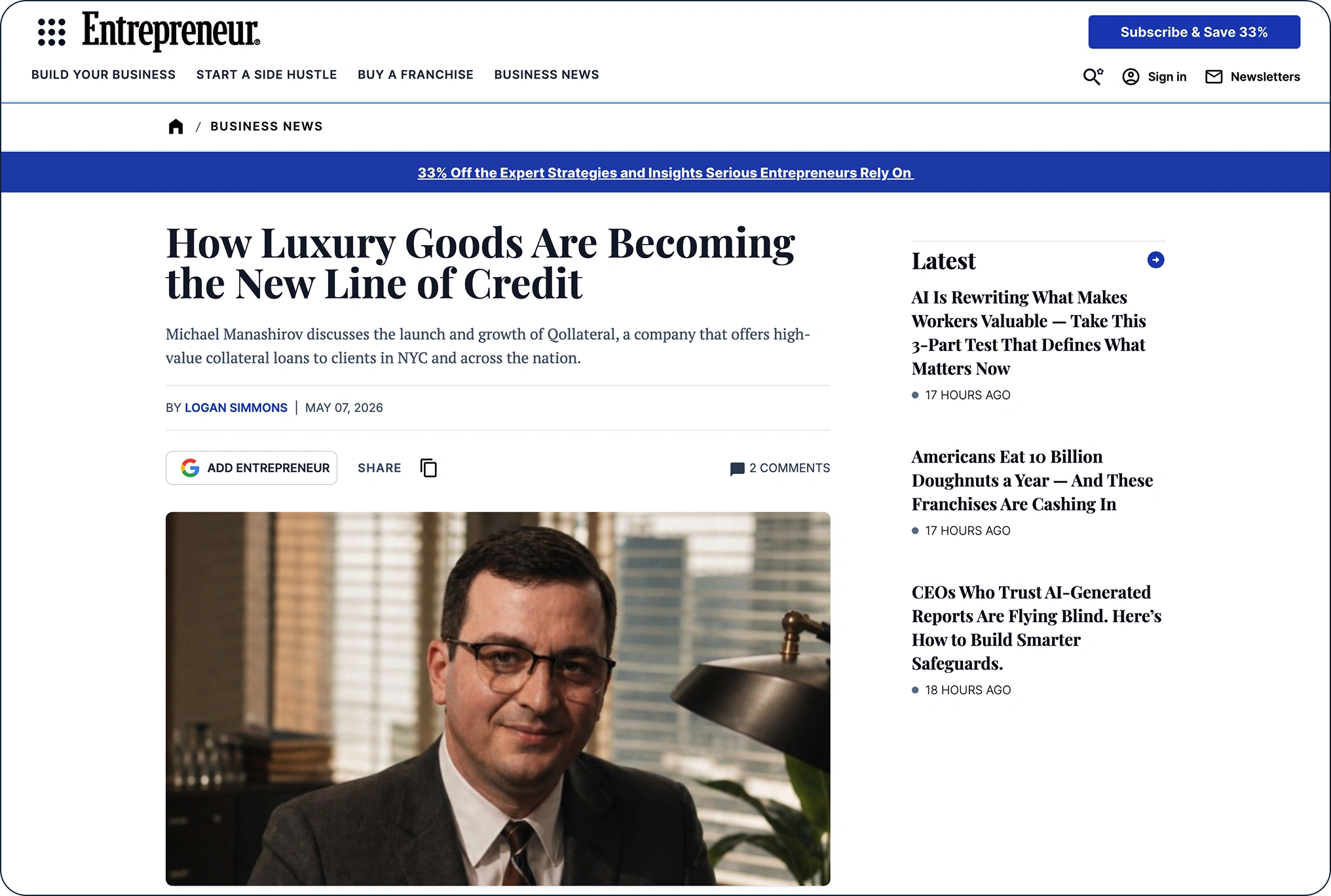
How Luxury Goods Are Becoming the New Line of Credit

How Luxury Goods Are Becoming the New Line of Credit

Michael Manashirov discusses the launch and growth of Qollateral, a company that offers high-value collateral loans to clients in NYC and across the nation.

By Logan Simmons | edited by Dan Bova | May 07, 2026

For decades, liquidity has followed a familiar path. Sell an asset, access capital, move on. Whether it’s equities, real estate, or collectibles, the assumption has been consistent: value is only truly realized once ownership is relinquished. But for a growing segment of high-net-worth individuals, that equation is beginning to shift.

Increasingly, wealth is being stored not just in traditional financial instruments, but in physical assets: luxury watches, fine jewelry, rare diamonds, even high-end handbags. These items are no longer viewed solely as personal possessions or status symbols. They are becoming part of a broader financial strategy. The challenge, however, has remained the same: how to access the value locked within them without triggering a sale.

This is the inefficiency that Michael Manashirov, Co-Founder and COO of Qollateral, a fully licensed & bonded, BBB A+ rated company, set out to address. With a background as a GIA-trained gemologist and years of experience appraising high-value assets, Manashirov had a front-row view into a persistent gap in the market. Clients often held significant wealth in tangible form, yet faced limited options when they needed immediate liquidity.

Traditional banking channels, while reliable, are not built for speed or flexibility. Approval timelines can stretch into weeks, and underwriting processes often fail to account for non-traditional forms of wealth. On the other end of the spectrum, legacy collateral lending models, often associated with pawn-based systems, lack the discretion and structural sophistication expected by high-value clients.

What emerges is a mismatch between modern wealth profiles and the systems designed to support them.

The rise of luxury asset-backed lending can be seen as a response to this disconnect. Rather than forcing a binary choice between holding and selling, it introduces a third option: leveraging ownership as a source of capital. In this model, assets such as watches, jewelry, and precious metals are evaluated not as collectibles, but as financial instruments with measurable, market-driven value.

This shift is not happening in isolation. Secondary markets for luxury goods and high-value collectible trading cards have matured significantly over the past decade. Timepieces from brands like Rolex, Patek Philippe, and Audemars Piguet, as well as Hermès Birkin and Kelly bags, now trade with a level of liquidity and price transparency that was previously reserved for more traditional asset classes.

As these markets have strengthened, so too has the case for using such assets as collateral in structured lending environments.

But while the concept may be straightforward, execution remains complex. Accurate valuation requires deep, specialized expertise. Market conditions can shift quickly, particularly in commodities like gold or in niche collectible segments. And perhaps most critically, trust plays an outsized role. Clients are not simply handing over assets; they are entrusting items that often carry both financial and personal significance.

Manashirov’s approach has been to build around these constraints rather than ignore them. By combining in-house appraisal expertise with institutional-grade security and transparent lending structures, the model attempts to bridge the gap between speed and credibility.

The emphasis on discretion is equally important. In many cases, the need for liquidity is tied to time-sensitive opportunities; real estate acquisitions, business investments, or private transactions where timing can determine the outcome. In these scenarios, the ability to access capital quickly, without public visibility or disruption to long-term holdings, becomes a strategic advantage rather than a convenience.

This is where the broader implications begin to surface.

If assets can generate liquidity without being sold, the role they play within a portfolio changes. Ownership becomes more dynamic. Instead of sitting idle, assets can function as tools activated when needed, then returned to their original place within a collection or investment strategy.

For entrepreneurs and investors, this introduces a new layer of optionality. Capital can be deployed without forcing exits from positions that may continue to appreciate over time. It also reduces the friction traditionally associated with accessing funds, particularly for those whose wealth is not concentrated in cash or publicly traded securities.

Of course, this model is not without its considerations. Lending against physical assets requires disciplined risk management, particularly in volatile markets. Loan-to-value ratios must be structured carefully, and real-time valuation becomes essential. Regulatory frameworks also play a role, shaping how these transactions are conducted and what protections are in place for borrowers.

Yet despite these complexities, the underlying trend is difficult to ignore.

As wealth continues to diversify beyond traditional financial instruments, the infrastructure surrounding it must evolve as well. The systems that once defined access to capital are being reexamined, not through disruption alone, but through adaptation to how value is actually held today.

What Manashirov’s perspective highlights is less about a single company or solution and more about a broader shift in mindset. Liquidity is no longer confined to what can be easily sold. It is increasingly tied to what can be intelligently leveraged.

In that sense, the future of finance may not be about creating new forms of wealth, but about rethinking how existing wealth can be used.

→ Read the article on Entrepreneur.

Get An Offer Within 30 Minutes
No Obligation • Private & Secure
Get Started
212-287-5257
Share This Post:
Content Disclaimer

The content provided by Qollateral, LLC is for informational purposes only, you should not construe any such information or other material as legal, tax, investment, financial, or other advice. Nothing contained on our Site constitutes a solicitation, recommendation, endorsement, or offer by Qollateral, LLC or any third party service provider to buy or sell any commodities, securities or other financial instruments in this or in in any other jurisdiction in which such solicitation or offer would be unlawful under the securities laws of such jurisdiction. Qollateral, LLC is not an attorney, accountant or financial advisor, nor is it holding itself out to be, and the information contained on this Website is not a substitute for financial advice from a professional who is aware of the facts and circumstances of your individual situation.

All content on this site is information of a general nature and does not address the circumstances of any particular individual or entity. Nothing in the Site constitutes professional and/or financial advice, nor does any information on the Site constitute a comprehensive or complete statement of the matters discussed or the law relating thereto. Qollateral, LLC is not a fiduciary by virtue of any person’s use of or access to the Site or any content contained therein. You alone assume the sole responsibility of evaluating the merits and risks associated with the use of any information or other content on the Site before making any decisions based on such information or other content. In exchange for using the Site, you agree not to hold Qollateral, LLC, its affiliates or any third party service provider liable for any possible claim for damages arising from any decision you make based on information or other content made available to you through the Site.

Recommended Resources

How Luxury Goods Are Becoming the New Line of Credit

Michael Manashirov discusses the launch and growth of...

Qollateral Expands Nationwide Loan Services to Meet Growing Demand for Alternative Lending Across Texas

New York-based luxury collateral lender brings appraisal expertise...

Gold Spot Price Explained: What Determines the Real-Time Value of Gold

The gold spot price explained simply: this term...

Image

Unlock The Equity
In Your Assets.

Maximize your financial potential by
unlocking the equity in your assets.

Get Started
Chat