
 Updated September 29, 2026
 6 minute read
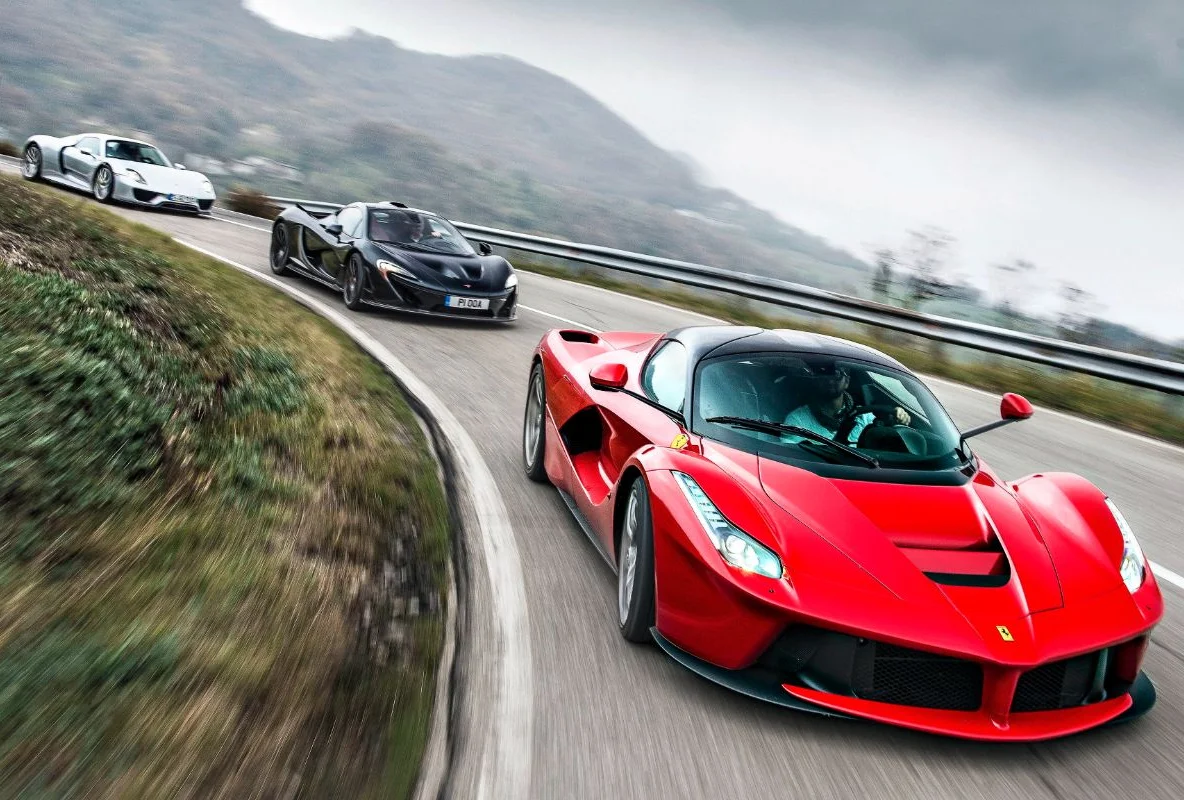
The holy trinity of hypercars is the Ferrari LaFerrari, McLaren P1, and Porsche 918 Spyder, three hybrid cars that reached buyers within months of each other around 2013. Each maker used electric motors to add speed rather than save fuel, and none built more than 918 cars. On October 9, 2026, Broad Arrow will offer all three at a single auction in Belgium. The sale is a rare chance to see how the market prices them side by side.
Holy Trinity of Cars History: How the Name Stuck
McLaren showed the P1 at the 2012 Paris Motor Show and began deliveries in 2013. Ferrari unveiled the LaFerrari at the Geneva Motor Show in March 2013, and Porsche began building the 918 Spyder later that year. With three rival flagships arriving in the same season, the motoring press compared them as a set, and the nickname stuck.
The Three Cars in the Holy Trinity of Supercars
Ferrari LaFerrari
Ferrari built 499 LaFerrari coupes and 210 open Apertas. A 6.3-liter V12 works with Ferrari’s HY-KERS hybrid system for about 950 horsepower combined, enough to reach 60 mph in under 3 seconds and pass 217 mph. The electric motor only adds power, so there is no electric-only mode, and the V12 is always running.
McLaren P1
Only 375 P1s were built, the fewest of the three. A 3.8-liter twin-turbo V8 and an electric motor produce 903 horsepower combined, and the car reaches 60 mph in about 2.8 seconds. It is the most track-focused of the group, with active aerodynamics and a drag reduction system. Its Instant Power Assist System uses the electric motor to fill gaps in turbo boost. For short distances, the P1 can also run on electric power alone.
Porsche 918 Spyder
The 918 Spyder is the most numerous of the three, with 918 built. A 4.6-liter V8 works with two electric motors, one driving each axle, for 887 horsepower and all-wheel drive, which neither rival offers. It reaches 60 mph in about 2.5 seconds, the quickest of the trio, and set a 6:57 production-car lap record at the Nürburgring. That, plus an electric-only mode, makes it the easiest of the three to use day-to-day.
How the Holy Trinity of Supercars Compares
| Ferrari LaFerrari | McLaren P1 | Porsche 918 Spyder | |
| Engine | 6.3-liter V12 plus HY-KERS | 3.8-liter twin-turbo V8 plus one motor | 4.6-liter V8 plus two motors |
| Combined output | About 950 hp | 903 hp | 887 hp |
| Driven wheels | Rear | Rear | All four |
| Built | 499 coupes, 210 Apertas | 375 | 918 |
| Electric-only mode | No | Yes, short range | Yes, short range |
| Recent value (excellent condition) | About $3.8M coupe; about $5.05M Aperta | About $1.7M | Varies widely by specification |
What These Cars Are Worth Today
Values for the three have diverged. The LaFerrari has held up best: Hagerty tracks excellent coupes at around $3.8 million and Apertas at around $5.05 million. The P1 peaked near $2.25 million in 2018 and has since settled closer to $1.7 million. P1s sold a second time at auction have often brought less than their first sale. 918 values vary widely with the specification. Paint-to-sample colors and the Weissach Package command large premiums, and the Weissach car at Broad Arrow’s October sale carries an estimate of €2.6 million to €3 million.
Now more than a decade old, the cars are past the first wave of buyers who could not get a new one. They are not yet old enough to be treated as true classics, and the LaFerrari and P1 have both faced reports of costly battery replacements. Values for all three rise and fall with the market, and past prices do not guarantee future ones.
The New Holy Trinity of Cars
Ferrari and McLaren have both revealed direct successors, the Ferrari F80 and the McLaren W1, announced in 2024 as hybrid flagships. A matching trio would need a Porsche successor as well. Other makers have tried different approaches. The Aston Martin Valkyrie uses a Formula 1-inspired V12 hybrid, and the all-electric Rimac Nevera drops the gasoline engine entirely.
Borrowing Against a Holy Trinity Car
Owners of the holy trinity of supercars can reach the value tied up in their cars without selling them. A collateral loan lets an owner borrow against the car and get it back when the loan is repaid. Qollateral lends $50,000 to $2.5 million against eligible vehicles, including collector-grade Ferrari, McLaren, and Porsche models. The loan amount is based on wholesale and secondary-market data rather than retail asking prices.
Loans are non-recourse (the car satisfies the balance, with no personal liability), require no credit check, and can be funded the same day. The car is stored, not driven, in a climate-controlled facility for the loan term, fully insured, and returned in the same condition.
The Holy Trinity of Hypercars, More Than a Decade On
The holy trinity of hypercars gave Ferrari, McLaren, and Porsche their first hybrid flagships. More than a decade later, the three are valued very differently, and the October auction will add a new set of prices to the record. For owners, that value can be used without a sale: a confidential appraisal from Qollateral shows what a LaFerrari, P1, or 918 could support as collateral.
Frequently Asked Questions
What is the Holy Trinity of cars?
The name is shorthand for three rival flagships: Ferrari’s LaFerrari, McLaren’s P1, and Porsche’s 918 Spyder. Before these cars, hybrid systems appeared mainly in economy cars. Reviewers in 2013 treated the three as the start of a new era for the fastest road cars.
How much did the Holy Trinity cars cost new?
The Porsche 918 Spyder started at $845,000, or $929,000 with the Weissach Package. The McLaren P1 cost about $1.15 million before options, and the LaFerrari about $1.4 million. All three now sell above their original prices, and the LaFerrari has gained the most.
Which Holy Trinity car is fastest on a track?
The margins are tiny. In one widely cited test, the same professional driver lapped all three back to back. The P1 was quickest at 58.24 seconds, followed by the 918 at 58.46 and the LaFerrari at 58.58. In a straight line, Autocar found the LaFerrari felt quickest, just ahead of the P1.
Why is the LaFerrari worth more than the rarer McLaren P1?
Rarity alone does not set these prices. McLaren built 375 P1s against 499 LaFerrari coupes, yet P1 values have tracked close to the 918’s, even though the P1 is more than twice as rare. Most observers put the gap down to Ferrari’s larger following among collectors.
Does battery health affect a Holy Trinity car’s value?
Yes. All three depend on high-voltage battery packs that age, and replacing one is expensive. A car with documented battery health and a full manufacturer’s service history is easier to value and sell. That documentation matters to lenders as well as buyers.
What do I need to borrow against a LaFerrari, P1, or 918?
A clean title and the car’s basic details: year, make, model, VIN, mileage, photos, and title status. Qollateral typically returns a preliminary offer within 30 minutes of receiving that information, then arranges verification and transport, with armored carrier service for vehicles valued above $100,000. Owners anywhere in the country can apply without visiting New York.
