
By Michael Manashirov, COO of Qollateral
Published March 2026 | 6-Minute Read
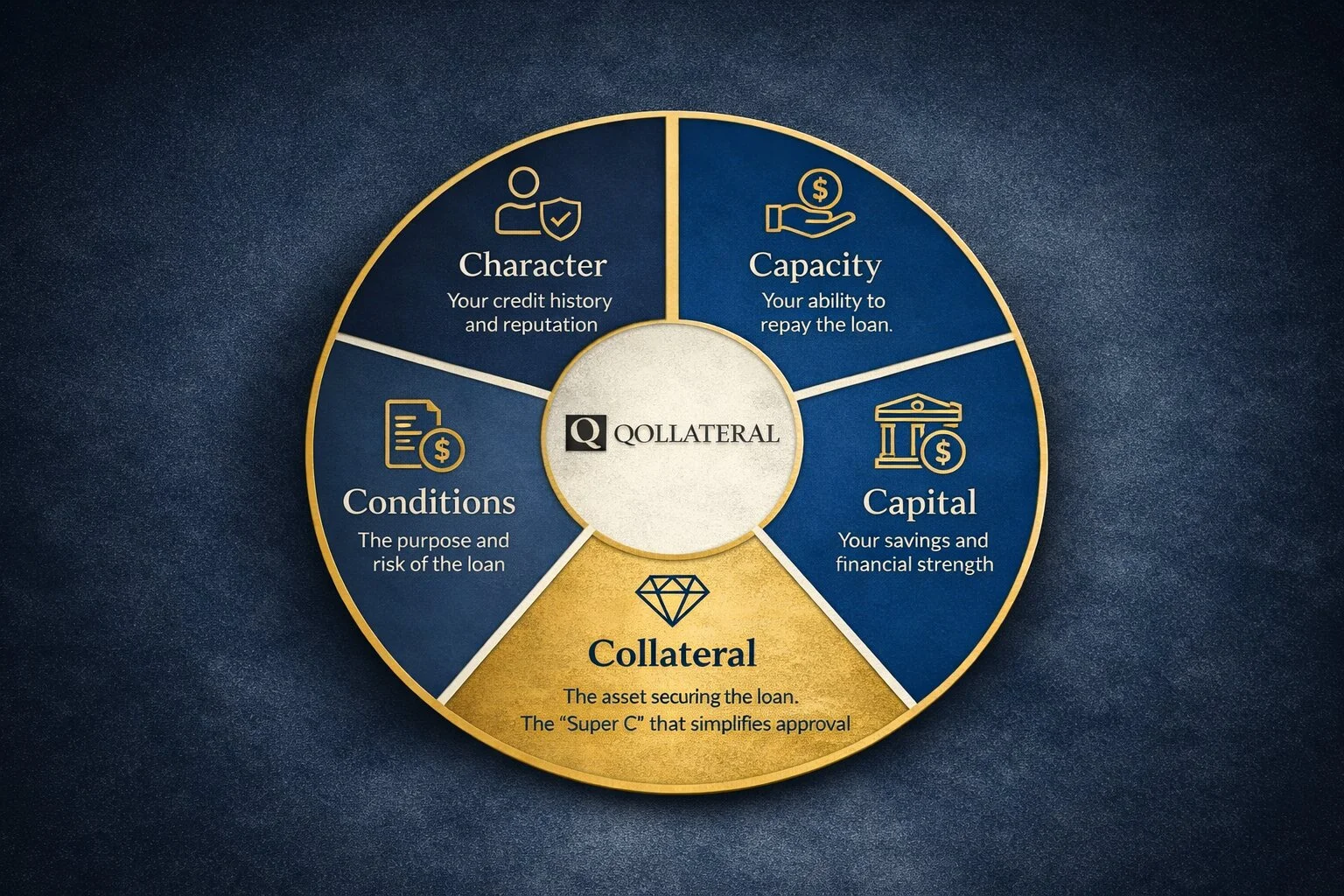
The 5 C’s of Credit are the criteria lenders use to decide whether someone qualifies for a loan. Character, Capacity, Capital, Collateral, and Conditions together paint a picture of a borrower’s financial history and their ability to repay.
It’s a reliable framework for traditional lending, but it tends to slow things down. What’s more, it keeps many people from getting approved. Credit collateral changes that. Instead of a person’s financial history, the focus shifts to something more tangible, such as a valuable luxury asset.
Let’s break down what the 5 C’s of lending are and how collateral lending makes accessing cash easier.
Key Takeaways
- The 5 C’s of Credit are Character, Capacity, Capital, Collateral, and Conditions. They are the foundation of traditional lending, but can limit access for some borrowers.
- Collateral lending changes the equation by focusing primarily on the asset’s value rather than the borrower’s credit history.
- What is collateral? A valuable asset (such as a watch, jewelry, or a handbag) is used to secure the loan.
- Collateral acts as a “Super C,” allowing lenders to approve loans based on asset value instead of all five factors.
- Compared to traditional loans, collateral loans are faster, more flexible, don’t require credit checks, and are more private.
What Are the 5 C’s of Credit?
Let’s first take a quick look at what each of the C’s is to understand how collateral changes lending.
Banks will take each of these factors into account. A weakness in one or more of these categories can impact the loan terms or even keep a borrower from getting approved for a loan in the first place.
Character: Also classified as “Credit History” at some banks. Character refers to your track record for repaying previous debts. This gives lenders a good idea of how well their clients will manage credit and make payments.
Capacity: Determines if the borrower can comfortably afford the loan payments. Income, job stability, and type of income all come into play.
Capital: Savings, assets, investments, and any money the borrower has invested in themselves that adds to their overall net worth. Capital matters because it can help repay the loan should the borrower lose their job.
Collateral: There are two main types of loans, secured and unsecured. Unsecured loans rely on the borrower’s credit history. Secured loans, on the other hand, are backed by an asset. Those assets are called “collateral” and can include high-end watches, gold, or even rare art.
Conditions: How the borrower plans to use the money. A car, a house, or a business expense are all fairly common. Lenders might not approve the loan if it feels at all uncertain or high-risk.
All About Collateral
That brings us to collateral. As we briefly covered above, collateral is, in simple terms, any tangible asset pledged as security for a loan. It’s usually a high-value asset that the lender can sell if the borrower stops making payments on the loan.
Collateral loans aren’t as risky for lenders because they can recoup funds if they have to. That also means the borrower’s credit score or financial history doesn’t come into play. Only the asset’s value.
That’s how collateral makes lending more accessible. Even if a bank says no, people can still access funding by using an asset they already own.
What is a collateral loan?
- Appraisal: The first step is to determine market value. How the money will be spent (conditions) and other traditional lending factors don’t apply here.
- Loan Offer: Anywhere between 50% – 70% of the asset’s market value.
- Agreement: At this point, the borrower will review and sign the loan document.
- Secure Storage: Assets are fully insured and stored in a secure vault during the loan terms. The borrower retains ownership the entire time.
- Funding: Funding is within 24 to 48 hours, either by cash, check, or bank wire.
What can be used as collateral for a personal loan? It varies from lender to lender. In most cases, high-end, easy-to-sell assets are the most ideal. Some pawn shops don’t accept higher-end assets, and even if they do, they might not have the expertise to properly value them to help customers secure the best offer.
Qollateral isn’t one of them. We accept most high-end assets such as:
- Luxury Watches: Rolex, Cartier, Patek Philippe, Audemars Piguet, Richard Mille, Omega, Hublot, and more.
- Fine Jewelry: Diamond rings, gold jewelry, branded items from names like Bvlgari and Tiffany & Co.
- Designer Handbags: Hermès and Chanel
- Gold & Silver Coins
- Rare Collectibles: Trading cards, sports memorabilia, comic books.
How Collateral Changes the 5 C’s Equation
Traditional loans come with a much higher risk because they aren’t secured by an asset. That’s why banks need to consider factors such as how the money will be spent and whether the borrower can afford the payments.
Asset-backed loans are different. Factors like conditions, character, capacity, and capital don’t matter as much because if the borrower finds themselves unable to continue payments, the lender simply sells the asset to recover the loan. The asset is the only liability. The loan does not affect their credit or any other assets they own.
You could even say that collateral acts as a “Super C.” Valuable assets are often enough to approve the loan. That’s why it works so well for entrepreneurs, self-employed borrowers, or even people trying to rebuild their credit.
Benefits of collateral-based lending include absolutely no credit checks, faster approvals (often within 24-48 hours), higher approval rates, competitive loan-to-value ratios (LTV), flexible payment terms, and complete privacy.
Visit Qollateral to learn more about lending, including more options for a loan against collateral.
Traditional Lending vs. Collateral Lending: A Comparison
To summarize:
Traditional lending follows all 5 C’s. It also relies heavily on the borrower’s credit and income. There’s slower approval timelines and lower approval rates for non-traditional borrowers.
Collateral lending uses the asset’s value as collateral. There aren’t any credit checks, so approvals and funding are quicker. This option is better for a much broader range of borrowers.
Common Questions About Collateral and the 5 C’s
Which of the 5 C’s of Credit is most important?
The answer to this question ultimately comes down to the lender. In collateral lending, collateral is the most important.
Can you get a loan with bad credit if you have collateral?
Yes. Asset-backed lending is based entirely on the value of the collateral, or asset. Credit history doesn’t matter.
Do lenders still check all 5 C’s?
Most traditional banks do. Collateral lenders only focus on asset value.
What happens if you default?
In a collateral loan, the lender will sell the asset to pay back the loan. It doesn’t affect your credit score.
How fast can you get approved?
Since they don’t involve any credit checks or financial reviews, collateral loans are typically approved within 24-48 hours.
Is collateral always required?
Not for all loans. It is if you’re trying to secure a collateral loan.
Making Collateral Work for You
The 5 C’s of collateral are an excellent framework for unsecured loans. It protects the lender and helps set the borrower up for success. They aren’t the only path to lending, though. Collateral is an easier, more flexible gateway to liquidity. One that relies on the asset itself rather than the borrower’s personal financial history.
If you don’t meet the criteria of the 5 C’s but still own a valuable asset, collateral lending might be an excellent solution to your cash flow needs.
Qollateral can help you tap into that with higher offers, safer storage, and more compassionate customer service.
Make an appointment today to get started.
- 100% Discreet
- 100% Safe
- 100% Secure
- 100% Risk-free
- 100% Insured
- 100% Satisfaction Guarantee
